
Perris Previous Residents by Era
A search for previous residents succeeds when each source is assigned an era and a question. Deeds can show ownership transfers. Directories and census schedules can suggest household occupancy. Permits can date construction or a project. Sanborn maps can show a building footprint. Obituaries and probate can close a life or estate trail. No row proves every person who lived at an address.
| Source | Years it covers | Where held | What it shows |
|---|---|---|---|
| Recorder web index | January 1, 1974 to present | Riverside ACR web service | Indexed parties, type, date, document number |
| Earlier deed books and indexes | County formation era to 1974; series gaps require checking | ACR Gateway, archives, FamilySearch | Grantor, grantee, legal description, chain of title |
| Assessor parcel result | Current parcel and displayed history | Riverside ACR web | APN, situs, improvements, transfer references |
| Reverse directory snapshots | 1971, 1976, 1980, 1985, 1992, 1995, 2000, 2005, 2010, 2014, 2017 | City-hosted environmental reports | Street, number, listed occupant or institution |
| Federal census | Public through 1950 | NARA, FamilySearch, library databases | Household members and historical location clues |
| Sanborn map | August 1890 sheet verified | Library of Congress and map collections | Building footprint, use, and address snapshot |
| Permits and planning | Digital and retained years require office confirmation | Perris Development Services | Project parties, work, dates, APNs |
The dates in the table are not interchangeable. A 2017 reverse entry, a 2025 transfer, and a 1950 census page answer different questions. Write the publication, filing, or enumeration date beside each clue.
Perris Address Records Start With APN
Start with the current situs in the ACR property search. Capture the nine-digit APN, legal description, tract or map reference, improvement facts, and newest transfer document number. The APN is the thread that can survive a street suffix change, a postal boundary mismatch, or an older legal description. A situs address tells where the parcel is. An owner mailing address can point elsewhere.
Open the transfer history and choose the newest document. Save the date, document number, and sale price when shown. Then search the recorder for the deed. Read the legal description before treating the grantor and grantee as the next link. A recorded owner is not automatically a previous resident, so the occupant trail begins only after the ownership chain is stable. That place key keeps the previous residents question tied to one parcel.
Search Perris Records Seller by Seller
A deed chain moves backward by changing the search role. The current grantee received the latest interest. Search that seller as an earlier grantee, narrow by date and document type, and compare the legal description. Repeat until the online index ends or the earlier instrument no longer matches the parcel.
- Normalize the parcel. Confirm the current address, APN, legal description, tract, and map reference.
- Open the newest transfer. Save document number, recording date, grantor, grantee, and vesting language.
- Search the seller backward. Use the seller as grantee before the sale, with date and document-type filters.
- Check the legal description. Keep only the instrument that follows the same land, not just a similar name.
- Repeat at the cutoff. Move to Gateway books and indexes when the web range no longer reaches the parcel.
- Grantor
- The party conveying or releasing an interest in a recorded instrument.
- Grantee
- The party receiving the interest.
- Chain of title
- The connected sequence of recorded transfers for the same parcel.
- Legal description
- The formal land description used to test whether two instruments concern the same parcel.
- Vesting
- The way the deed states the ownership interest is held, as shown in the instrument.
Perris Recorder Records Cutoff
Riverside’s recorder web index begins January 1, 1974, while county clerk documents begin January 1, 1893. Office computers cover recorder research from 1975 forward. Pre-1975 research moves to Gateway at 2724 Gateway Drive in Riverside, where earlier books and indexes can be checked. That cutoff changes the method, not the existence of the deed.
The Riverside ACR official records search offers name, document number, document type, map type with book and page, and advanced modes. The portal’s index can identify an instrument, but a paid copy is needed for the deed text. Online processing is stated at an average of 48 hours before mailing. In-person copies are generally same day unless older research is extensive.
The ACR copy guidance image below links to Riverside record-copy instructions.
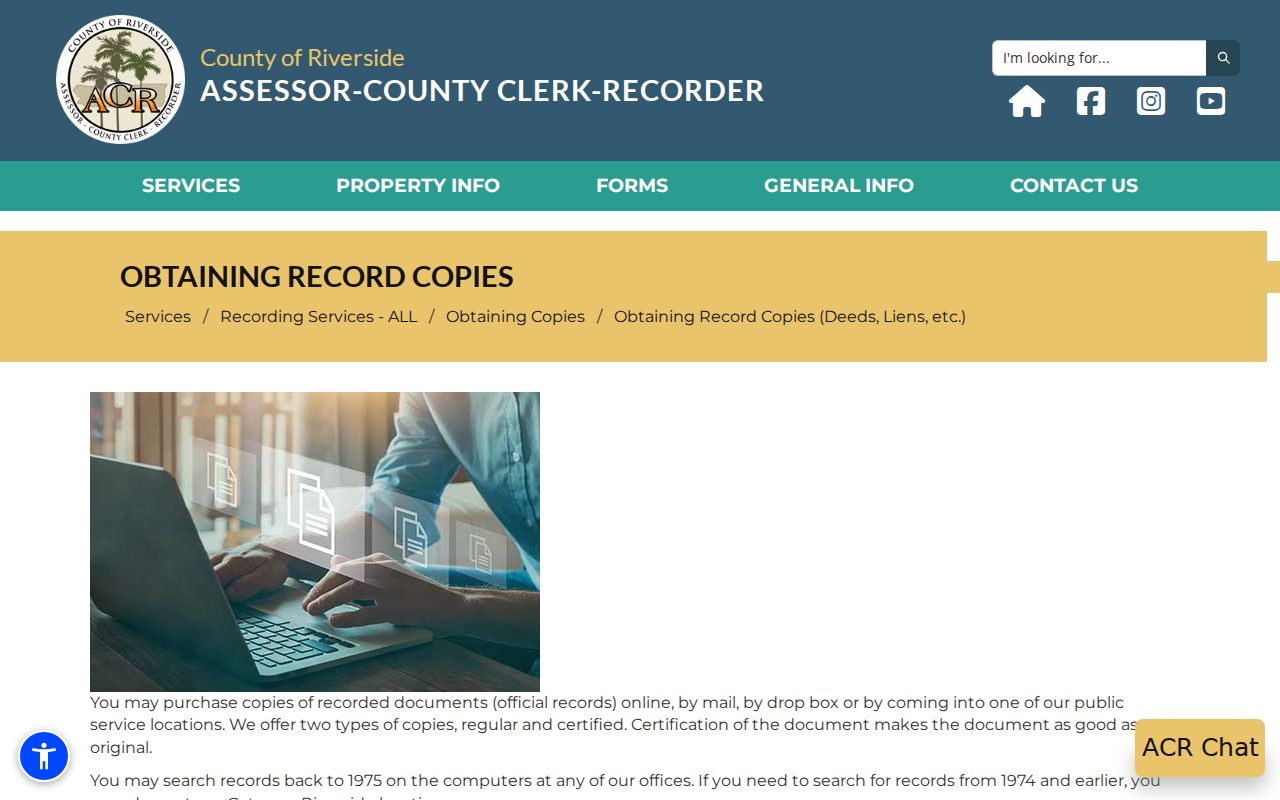
Use a transfer document number whenever possible. A mail request without one should include complete party names, instrument type, estimated recording date, and APN; for pre-1976 requests, the staff search window is limited after the estimated year.
Use Perris Records Search Modes
The recorder’s search-mode screen is useful because an address is not the main index key. Name Search works with last name, first name, and middle initial. Document Number Search uses the number from the assessor transfer history or a citation. Document Type Search narrows the instrument class. Map Type and Book/Page Search can help when a recorded map or reference has already been found.
| Name | Individuals can be entered as Last First MI without punctuation; broader last-name and first-initial searches may find variants. |
|---|---|
| Recording date range | Optional start and end dates narrow a common name. |
| Document type | Choose deed, deed of trust, reconveyance, lien, release, notice, map, or another displayed class. |
| Document number | Use a year and number format when the parcel result provides one. |
| Book and page | Use the map type plus recorded book and page in map mode. |
Exact matching, wildcard behavior, and copy checkout are separate parts of the process. The index date identifies recording, not occupancy. Keep the deed image with the parcel notes and do not call a party a previous resident until another source supports that statement.
The recorder search-mode capture is available from the Riverside ACR official-records portal.
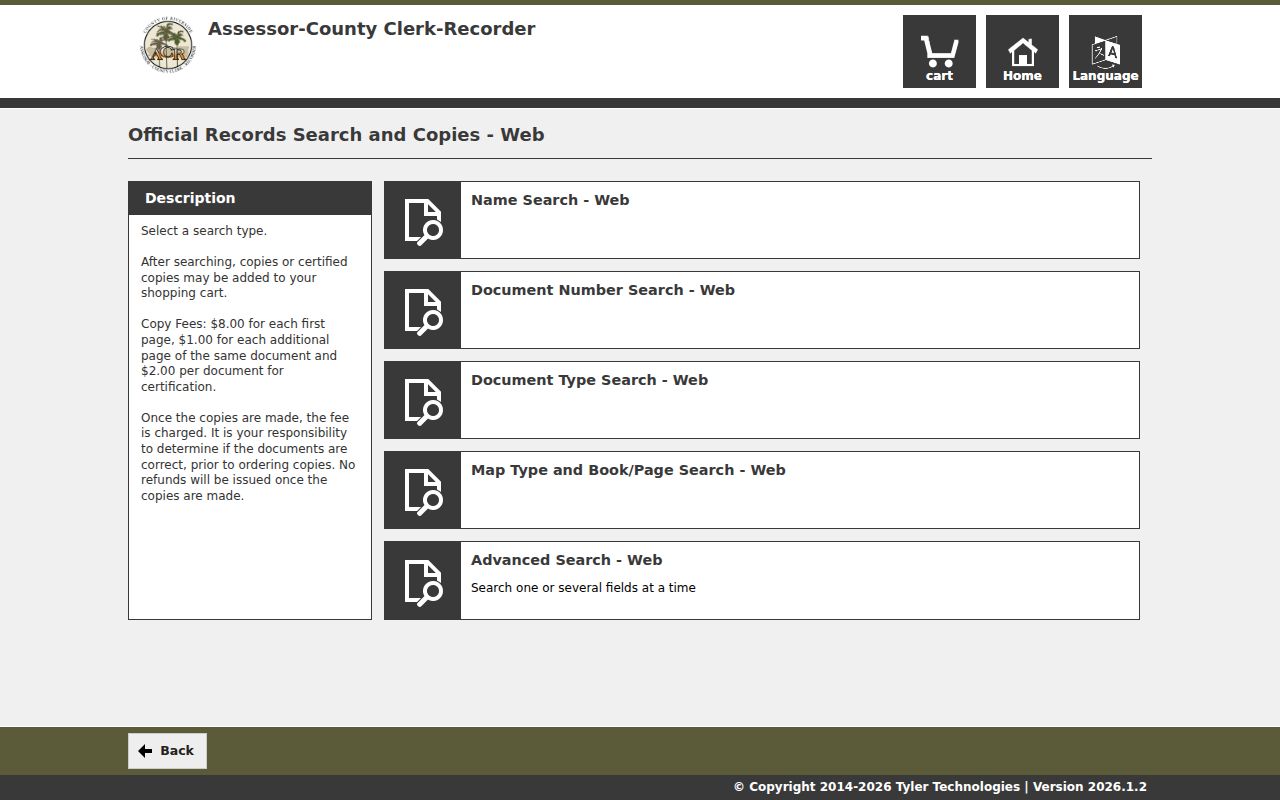
The image reinforces the distinction between name, document, map, and advanced searches when an address is being traced through time.
Separate Perris Owners and Occupants
Ownership is a legal and recorded relationship. Occupancy is a historical household question. A parcel result can show a single-family dwelling, value history, improvements, and transfers, but the public web display does not provide a resident roster. A deed can show a grantor or grantee, but not every person at the address. A business or entity owner may have a mailing address that differs from the situs.
For the occupant layer, use verified reverse-directory pages, the 1950 or earlier census, local newspapers, school publications, cemetery or obituary records, and probate when relevant. A directory can omit a person, use a prior street form, or cover only developed areas. Compare at least two clues before writing “lived here.” That distinction keeps previous residents research from becoming an owner list.
Pair Perris Directories With Census
The verified reverse-directory run includes Haines Criss-Cross snapshots for 1971, 1976, 1980, and 1985, plus EDR, Cole Information, and Dun & Bradstreet snapshots for 1992, 1995, 2000, 2005, 2010, 2014, and 2017. The reports show street headings, numbers, and surname-first occupants or institutions. They do not establish a full publisher run or every street.
For a much older address, pair a directory clue with the 1950 census or an earlier schedule. Census records can show household members, ages, birthplace, and occupation, while an address directory can narrow the street. Use the two sources as checks, not as one merged database. NARA at Riverside, 23123 Cajalco Road, is appointment-only Monday through Friday from 9 to 4 and holds federal records that can support the trail.
The Perris directory book page explains the collection gap and entry-reading method. This page uses those collections only to follow one address backward.
Date a Perris House With Permits
Planning, building, environmental, and code files can help place a structure or project in time. A permit may name an applicant, contractor, owner, APN, project number, work type, or date. Specific-plan reports may include parcel tables, road names, neighboring parcels, maps, and annexation context. Use the city planning page or a narrow City Clerk request when a posted file does not answer the question.
The permit trail does not replace the deed chain. It can date construction or remodeling and explain why an address appears in one directory but not another. Code Enforcement’s published workflow checks existing enforcement, violation history, and ownership before an inspection normally begun within 30 days, but no public case-name index was located. Keep the file’s project number and address beside the deed notes.
Rural Routes, Tracts, and Perris Streets
Modern Perris street names do not guarantee historical continuity. Downtown has numbered and lettered streets. Newer subdivisions use tract and lot descriptions, curving streets, and nine-digit APNs. Older valley records may use rural routes, township and range, or a legal land description. Postal “Perris” can reach unincorporated land, and annexation can change jurisdiction without changing the mailing ZIP.
Carry the legal description and APN through the transition. Use city and county boundary maps, a recorded plat, a directory cross-reference, or an ordinance to prove a rename or renumbering. No comprehensive official Perris street-renaming chronology was located. A blank search is a prompt to test old forms, not a reason to invent a missing address history.
Close a Perris Trail With Probate
Probate and recorded successor documents can explain why an owner disappears from the deed chain. Search Riverside Superior Court probate, mostly online from July 1994, for the decedent, petitioner, case number, or estate clue. Then compare public successor or transfer documents with the parcel’s legal description. A public case may not display sealed exhibits, protected identifiers, or every family detail.
Obituaries, cemetery registers, newspapers, and death records can support the date of death, but each source has its own limits. A death entry is not proof that the person occupied the parcel at the time. Use the address, APN, spouse, estate, and date together. If the result remains uncertain, mark the trail unresolved. A previous residents trail can end without a defensible occupant name.
House-history use. Deeds, maps, directories, and probate records are appropriate for a documented family or property history. Keep the research narrow, lawful, and respectful of protected people and records.
Document Perris Research Gaps
The Library of Congress collection verifies one August 1890 Perris Sanborn sheet. No later Perris Sanborn year was verified. No authoritative source established a classic alphabetical Perris publisher and complete year run. Those are real research gaps. The correct note is “not verified,” followed by a library, museum, UCR, or State Library inquiry, not an invented map or directory date.
The National Archives at Riverside image below links to the Perris research-room page. NARA describes federal court, land, naturalization, military, census, immigration, maps, drawings, and photographs, with appointment-only research-room access. It can supply a federal or predecessor-county clue, but it is not a public Perris resident list.
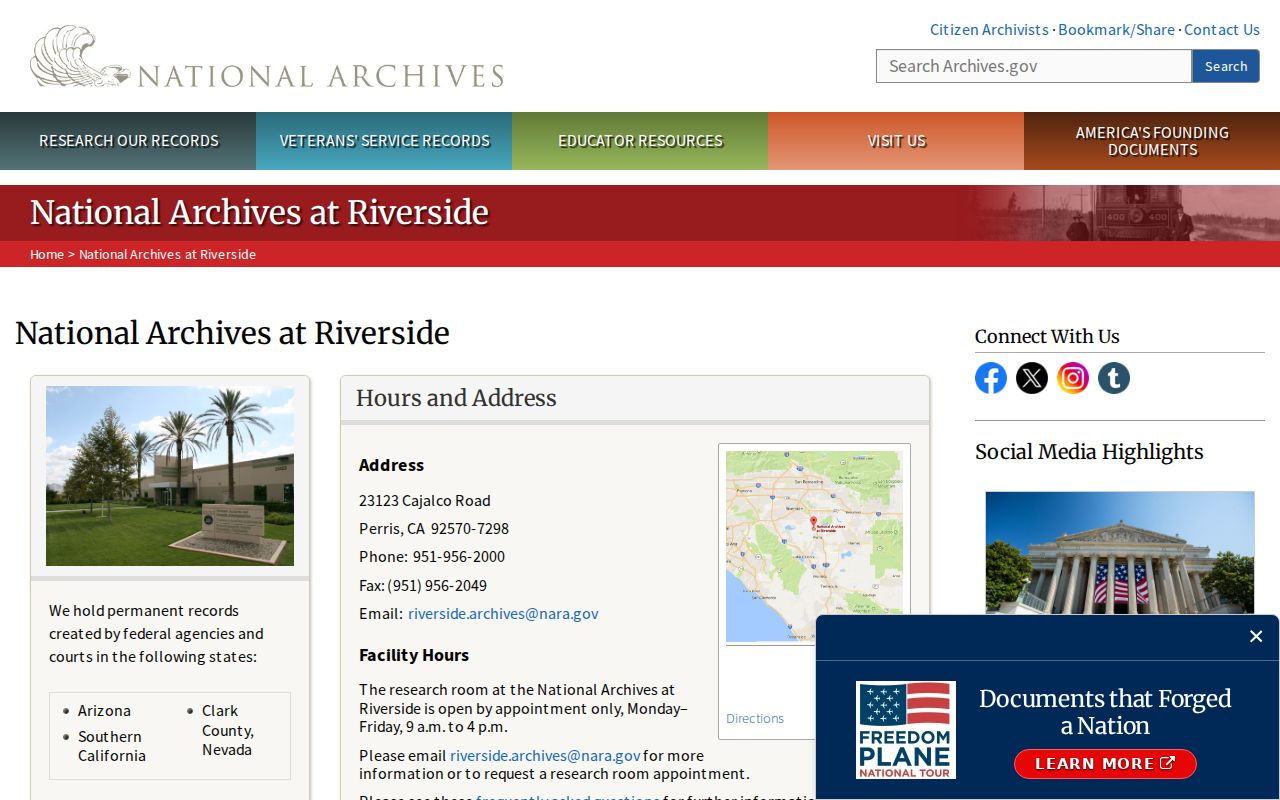
Previous residents research is strongest when the final notes show the exact document, edition, page, map, or repository that supports each step. A documented gap is better than a smooth story with no source.
Perris Past Households in Records
Past households sit at the intersection of the deed chain and the historical shelf. Use the current parcel to define the land, the recorder to follow owners, the reverse directory or census to test occupants, and obituary or probate material to explain an endpoint. The result may identify several previous residents, one owner who never occupied the address, or no reliable occupant at all.
When the question becomes current street context, the Perris street directory follows the address-keyed parcel and planning records. When it becomes a collection question, the historical city-directory page handles publishers and edition notes. Keeping those angles apart makes a previous-residents search more accurate.
A careful address history says what the source proves, what the source suggests, and where the record trail stops. The final previous residents note should preserve that boundary.