
Start With a Perris Resident Question
A good Perris residents directory search begins with a narrow question. A current parcel question calls for the Riverside County Assessor-County Clerk-Recorder, or ACR, property screen. A past owner question calls for the recorded deed chain. A question about your own registration belongs in California My Voter Status. A family-history question may begin with a census page, an obituary, a newspaper, or a library directory. A business connection belongs in an official entity or license index, not in an assumption that a business address is a home.
The official trail has clear gaps. The assessor web result is rich in APN, situs, valuation, legal description, and transfer references, yet public owner-name display is restricted. The voter page authenticates the voter who is checking a record; it is not a street browse. Deeds name parties to an instrument, but they do not prove who slept at the address. Directories may omit a household, and an occupant may never appear in a property file. A useful Perris residents directory workflow keeps those limits visible.
- Set the starting clue. Write down the exact name, address, APN, event date, case number, or business number you have. Preserve Spanish compound surnames, accents, hyphens, and former names.
- Anchor the place. Use the ACR property search or a city or county map to confirm the situs, jurisdiction, parcel number, tract, and map reference.
- Bridge to the record. Use a transfer document number in the recorder index, or use the court division and case number when the trail is a legal filing.
- Add an independent clue. Pair a deed with a census or newspaper, a court result with an address, or a directory entry with a vital or probate record.
- Use the custodian for the gap. Ask the City Clerk, county office, library, archives, or court clerk for a defined record, date span, and format when a web index stops.
Note: A name plus Perris is a lead, not an identity match; add a date, address, parcel, or record number before drawing a conclusion.
Perris Resident Records Offices
Perris is not the Riverside County seat, so the records desk is spread across City Hall, county offices in Riverside County, state systems, and federal repositories. The City Clerk is the place for city-created minutes, ordinances, agreements, planning and building records, disclosure filings, and other municipal series. ACR is the decisive county custodian for parcels, deeds, certificates, and clerk documents. The Registrar of Voters controls voter administration. Riverside Superior Court keeps trial case indexes, while PACER covers federal matters.
Riverside County ACR
Recorder, assessor, and county clerk functions
Gateway office: Riverside, CA
951-486-7000
ACR office gateway
Riverside Registrar
Voter administration and election records
Riverside County
951-486-7200
Registrar services
Perris Library
163 E. San Jacinto Avenue
Perris, CA
951-657-2358
Branch information
Use the Perris NextRequest portal for a searchable city request path, but name the department and record series. The City Clerk’s posted copy schedule lists 50 cents for the first page and 20 cents for each following page, with a lower per-page rate for FPPC material. The county, court, and state offices have separate rules. Sending a city request for a county birth certificate will only add a delay.
Perris Assessor Records by Field
The Riverside County ACR Property Search is an address and assessment-number tool. It does not operate as a public owner-name directory. Start with the street address when the parcel is known, then save the nine-digit PIN or APN and the legal description. A transfer reference can later bridge the parcel to the recorder, which is more useful than repeating a broad name search.
The public result can show property address, assessment number, APN or GeoCode, property type, tag, acreage, business-use flag, legal description, lot and tract information, value history, similar sales, improvements, and transfer dates with document numbers and sale prices. The sample result for 1395 Giosetta Street illustrates why an APN is a stable anchor. A mailing address is a separate field and can belong to an entity, an agent, or an owner who does not live at the situs.
- Property Address
- Text, one key. Use the street number and name, then try a simpler suffix if needed.
- Assessment Number
- Text, one key. The nine-digit PIN or APN is often entered without hyphens.
- Search
- Button, required. It opens the matching valuation record.
- Transfer History
- Optional result tab with date, document number, and sale price when displayed.
The assessor screen is worth checking before a recorder search because its transfer number can narrow the exact document. The property data also updates on a schedule, so a displayed date matters. A county tax-account view adds another parcel clue, but its mailing party still may not be the occupant. Treat every result as parcel evidence, not proof of a current household.
The county ACR gateway image below shows the kind of property-search interface used for a Perris parcel. The county ACR gateway is the source for the office and its related services.
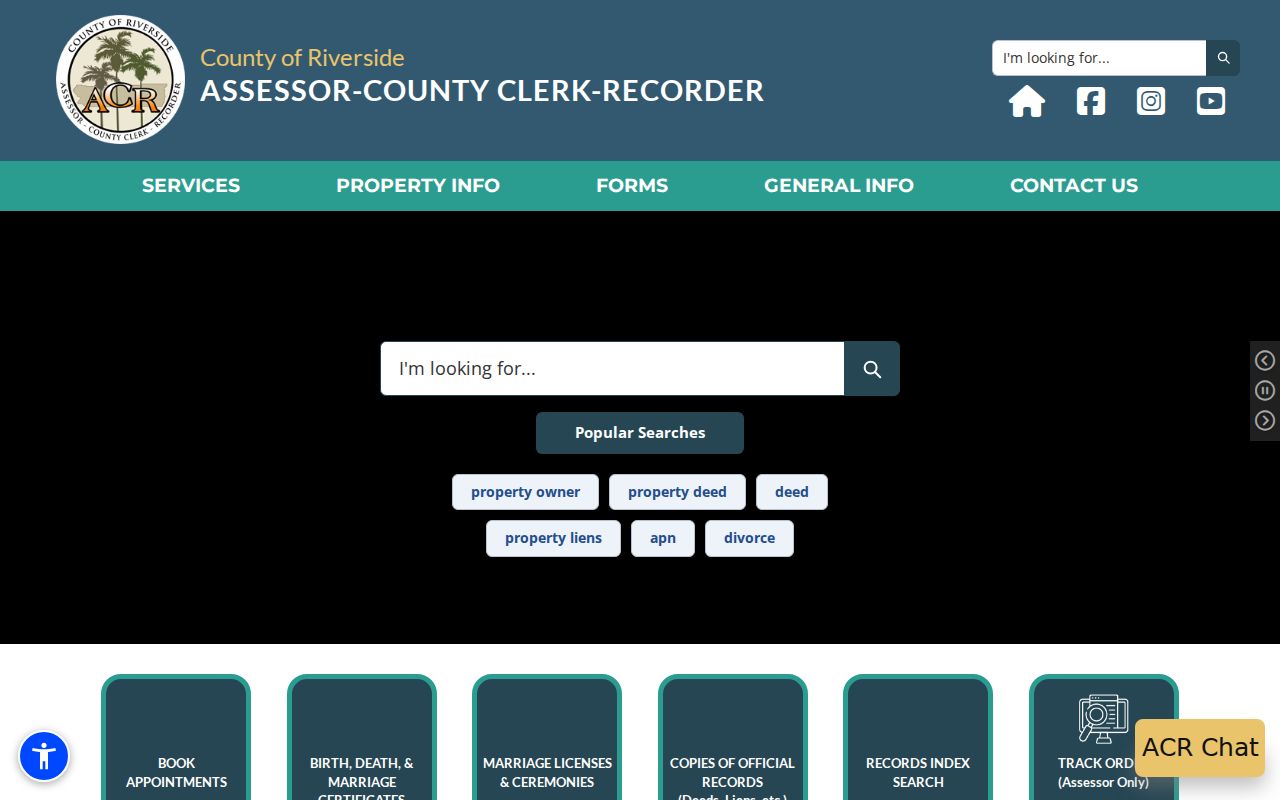
The visible tabs for tax information, similar sales, value history, and a property report help a researcher move from a street clue to a record number without treating the screen as a household roster.
The Perris Recorder Cutoff
Riverside County’s online recorder index begins January 1, 1974. County clerk documents begin January 1, 1893. Public office computers cover recorder research from 1975 forward, while pre-1975 recorder work moves to the Gateway office at 2724 Gateway Drive in Riverside. This is a search boundary, not a boundary in the records. A Perris deed from before the web range may still exist in a book or index.
The Official Records Search offers name, document number, document type, map type with book and page, and advanced search modes. Name searches use a last-name, first-name, middle-initial style. Exact and wildcard behavior can change the result set. A document index may show party names, role, type, recording date, document number, and map reference. The deed image is a separate copy request.
Regular copies cost $8 for the first page and $1 for each additional page, with a $2 certification charge per document and a 2.15 percent online card fee according to the research source. Online processing is stated at an average of 48 hours before mailing. In-person copies are often same day, though older research may take longer. Mail requests should include names, instrument type, estimated date, and APN when known.
Note: Use a transfer document number from the parcel result when possible; it keeps a common Perris surname from producing a long, costly list of unrelated instruments.
Current Perris Resident Directories
No current Perris residents directory is complete by itself. Each source describes a different relationship to a place. The assessor describes a parcel. The recorder describes parties to an instrument. The voter system describes a person’s own registration or a tightly controlled file request. A city staff page identifies a public official, while a license or business filing identifies an affiliation. The table keeps those meanings apart.
| Source | Who or what appears | Keeper | Access |
|---|---|---|---|
| Assessor parcel result | Situs, APN, value, transfer references | Riverside County ACR | Free web display |
| Recorded instrument index | Grantors, grantees, liens, maps | ACR Recorder | Free index; paid copies |
| My Voter Status | One voter’s status, address, and election details | California Secretary of State | Identity-gated self lookup |
| City records | Officials, applicants, agreements, project parties | Perris City Clerk | Posted records or request |
| License and business files | Professional or entity affiliation | California and county custodians | Public search, record-specific |
For one person, compare only records that answer the same question. A recorded grantee may have owned a parcel without living there. A business agent may receive mail at a filing address. A voter result is a self-service status check, not a public list of every name at a street. These distinctions are the difference between a useful resident directory and a misleading name pile.
Perris Voter Status Limits
California My Voter Status asks for first name, last name, date of birth, and either a California driver license or ID number or the last four digits of a Social Security number. It is designed for a voter to check a personal record. It can return registration status and address, party preference, language preference, polling place, election information, and vote-by-mail or provisional-ballot status after authentication.
| First and last name | Enter the name as registered. |
|---|---|
| Date of birth | Use the month, day, and year selectors. |
| California ID | Supply the exact number or choose the no-number path. |
| Last four of SSN | Use the alternative identity field when applicable. |
| Submit | Authenticate, then close the browser when finished. |
A qualified voter-file request is a different channel. California Elections Code section 2194 permits approved election, scholarly, journalistic, political, governmental, and specified investigative uses. The statewide file costs $100. A specific-voter request can name up to ten voters, requires full name, date of birth, county, and residence address, and costs $30 per record with a $100 cap. The file can contain residence and mailing addresses, precinct, party preference, districts, and voting history, but it excludes driver license numbers, state ID numbers, Social Security digits, unique identifiers, and signatures.
The California voter status page is a personal check, not a street directory. A protected Safe at Home address must not be exposed. Recent registration can take at least 24 hours to appear, and inactive or canceled status needs corroboration before anyone says a person moved.
The source image for the voter status form is linked through the California Secretary of State lookup.
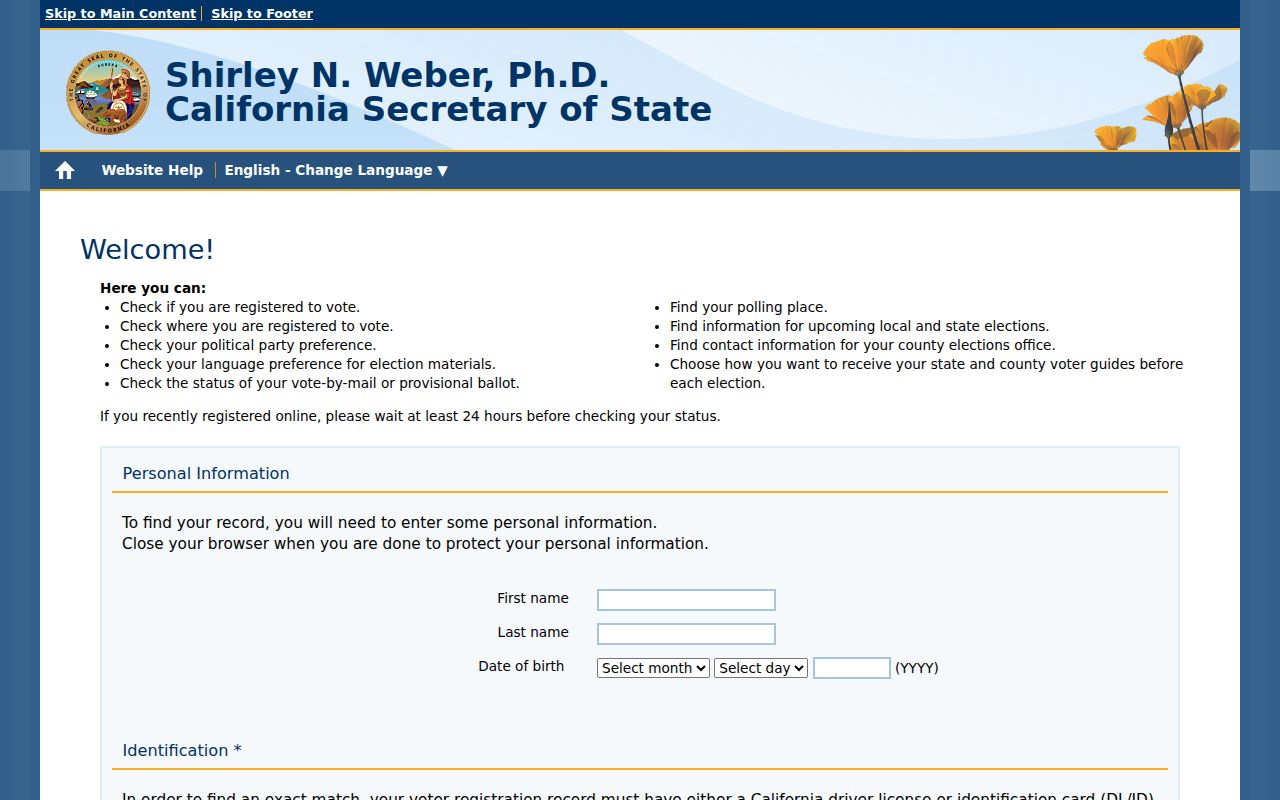
The identity fields in the image explain why a public user cannot turn My Voter Status into a block-level resident roster.
Perris Court Records by Division
Perris trial matters sit in Riverside Superior Court, not in a separate Perris municipal-court database. The Riverside Superior Court public access page divides civil and small claims, family law, probate, and criminal or traffic searches. Electronic coverage depends on division and courthouse. A missing result can reflect a purge, a sealed file, a restricted document, or a date outside the stated range.
| Division | Coverage stated | Useful result | Next access |
|---|---|---|---|
| Riverside civil | October 1991 to present | Case number, parties, events, status | Clerk search or copy request |
| Family law | Almost all from April 1992 | Case index and filing clues | Restricted documents stay closed |
| Probate | Almost all from July 1994 | Estate parties, petitions, heirs when public | Clerk for copies |
| Criminal and traffic | Branch ranges begin around 1990 to 1996 | Case information and events | Access rules and purge limits |
The public portal is informational, not the official court record. The RI-MC002 request form lets a requester give party names, identifiers, case type, court location, search years, document description, copy type, delivery method, and payment information. Certified records require clerk fulfillment. Federal civil and bankruptcy matters use PACER, not the Riverside trial portal.
Perris Vital Records Access
Riverside County ACR issues county birth, death, and marriage certificates. The California Department of Public Health, or CDPH, maintains statewide records and forms. California vital access is not a simple “closed for a set number of years” rule. Informational copies of nonconfidential birth, death, and public marriage records may generally be available to any requester, while an authorized certified copy is limited by Health and Safety Code sections 103526 and 103526.5. Confidential marriage records are restricted by Family Code section 509.
- Birth
- Riverside ACR or CDPH. Informational or authorized copy. 2026 fees are $34 county or $31 state.
- Death
- Riverside ACR or CDPH. Informational or authorized copy. The listed 2026 fee is $26.
- Public marriage
- Riverside ACR or CDPH. An informational copy is generally available. The listed 2026 fee is $19.
- Confidential marriage
- Issuing county clerk. Spouses or court order control access. The county fee is $19.
- Divorce certificate
- CDPH issues the certificate while the court holds the file. The listed CDPH fee is $18.
The Riverside vital-record page supports online, mail, and in-person orders. The CDPH vital-record hub supplies statewide forms, while the published fee schedule records the 2026 amounts. Authorized copies require identity verification or a sworn statement with notarized acknowledgment. County ACR can issue a certificate only for a Riverside County birth or death, or a marriage license issued there. A no-record search returns a Certificate of No Record, which is different from proof that an event never happened.
The county application image below comes from the Riverside vital-record page. The ACR office gateway remains the place to confirm current forms and charges.
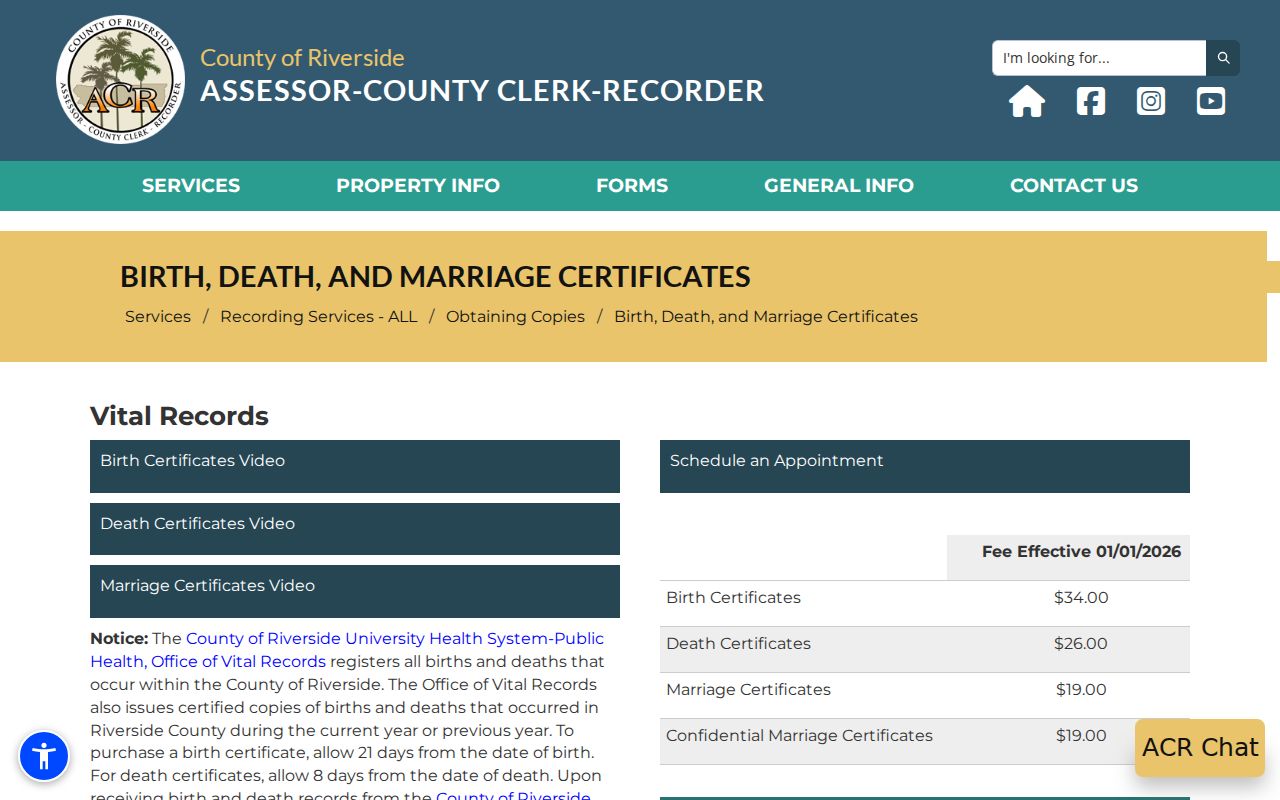
Use the record type, event place, and eligibility category as separate checks. Historical statewide indexes can lead to a certificate, but the index and the certified document serve different purposes.
Find Perris Heirs Through Probate
When a Perris address trail ends with a death, probate can connect the decedent, petitioner, heirs, and successor documents. Riverside probate cases are mostly available in the public portal from July 1994 forward, but public access does not mean every exhibit is open. Pair a probate case with the recorder’s successor or transfer documents and the parcel’s legal description. The goal is to trace a documented estate path, not to infer a family relationship from a surname.
A narrow route is often enough: identify the parcel and newest transfer, read the deed for the grantor and grantee, search the prior owner in the court probate division, then check recorded successor documents. If a person was an occupant but never an owner, switch to newspapers, an obituary, a census schedule, a directory, or a school and community publication. Each source should carry its publication or filing date.
Personal research. Probate, deed, and obituary records can help with family history and estate work. Use only lawful, respectful methods, and leave protected or sealed material with the custodian.
Historical Perris Resident Directories
Perris’s historical resident directory shelf is a mix of regional directories, newspapers, census schedules, reverse listings, and local archives. No authoritative catalog verified a complete standalone Perris publisher run. A city-hosted environmental report does verify reverse-directory snapshots for 1971, 1976, 1980, 1985, 1992, 1995, 2000, 2005, 2010, 2014, and 2017. The report is evidence of those consulted editions, not proof that every year or every street appears.
The Perris Library is the first local inquiry point for county catalog records, microfilm, genealogy databases, interlibrary loan, and newspaper help. The county library history is unusually useful: a first library operated in Henry Akin’s D Street general store in 1882, the county system formed in 1911, a 4th Street library followed in 1916, and the current Cesar E. Chavez Library opened on San Jacinto Avenue in 1994 after later moves through City Hall and the former post office. The Riverside County library history preserves that institutional trail.
The image below links to the Perris Library branch page, where current hours and services should be confirmed before a visit.
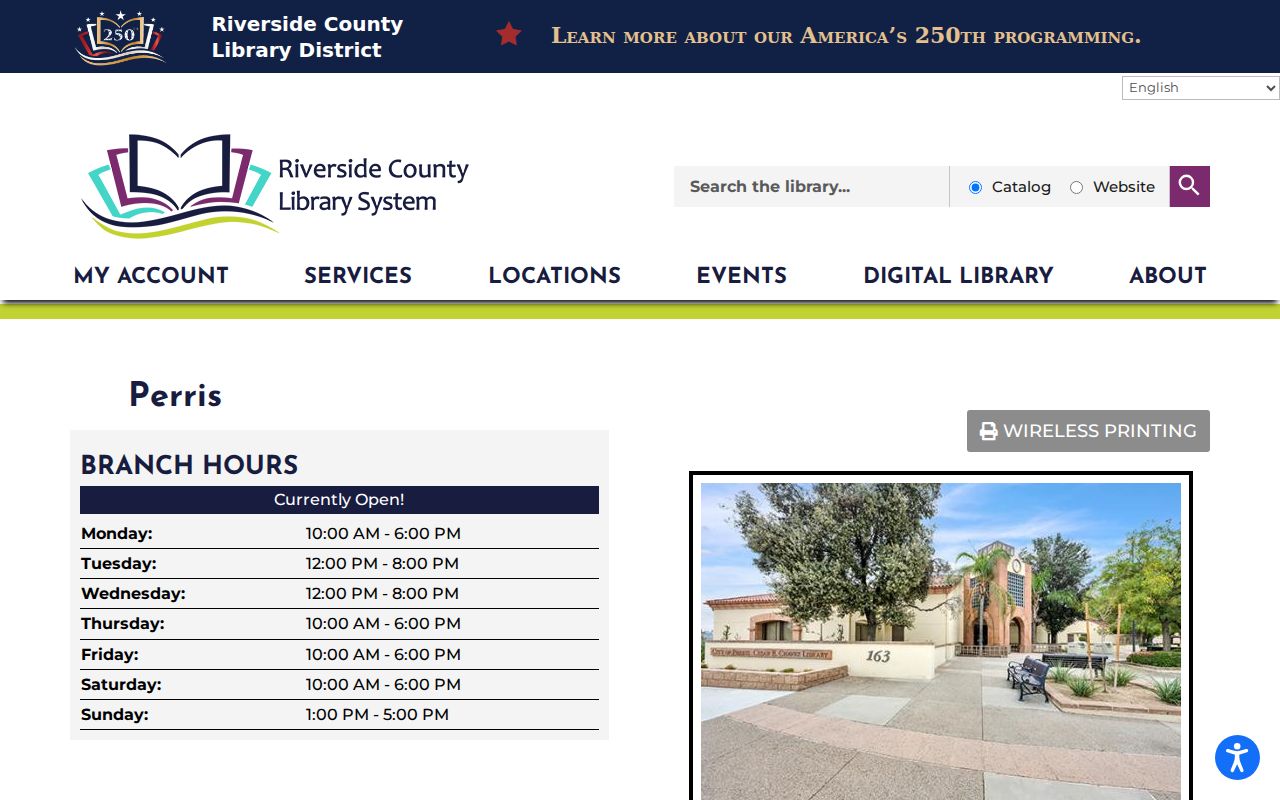
For older names, search the library catalog with Perris directory, Riverside County directory, telephone directory, cross reference, criss cross, Haines, and Polk. Ask staff to verify publisher, inclusive years, gaps, and whether a volume is alphabetical or address ordered.
Perris Business Name Affiliations
A business or professional record can help distinguish a person with a common name, but it does not turn a filing address into a home address. The California Secretary of State’s bizfile Online can return entity name, number, type, status, jurisdiction, agent, and filed documents. The Department of Consumer Affairs license search can return license identity, status, city, and discipline links as each board permits. Riverside fictitious business name records and Perris business-license files add local context. The State Controller’s unclaimed-property search is another name clue, but a claim requires identity evidence.
The city’s HDL licensing portal has search and account functions for licensed businesses. City license records confirm a regulatory filing. They do not prove that a beneficial owner lives at the business address. Use the entity number, license number, filing date, or document number as the independent identifier when two names look alike.
The business-search image below comes from the official state entity-search link. It shows why an entity result should be read as an affiliation record with its own limits.
For a city-created record, request a defined series from the City Clerk, such as permits for one APN or agreements for one project and date range. Do not ask an office to create a resident list from unrelated files.
Perris CPRA Request Route
The California Public Records Act, Government Code sections 7920.000 through 7931.000, gives every person a right to inspect nonexempt state and local records. An agency generally must determine within ten calendar days whether it has responsive records, with an unusual-circumstances extension of up to fourteen additional days. That is a determination deadline, not a promise that production will happen on that date.
Write to the actual custodian. For city records, use the City Clerk or NextRequest. For county deeds, use ACR. For police records, use the Riverside County Sheriff Records Bureau. Ask for an existing record, narrow date span, address or APN, project number, and electronic format when held. Request reasonably segregable portions if an exemption covers part of a record. Duplication charges and statutory copy fees vary by office.
CPRA is a fallback for a missing record, not a tool that forces an agency to answer a question or build a new database. A clear request for permits at one APN is easier to route than “everything about” a person. Keep the request and response together so a later Perris residents directory search has a source trail.
Perris Resident Lookup Privacy
California protects some data even when a related record is public. Safe at Home supplies a substitute mailing address and confidential forwarding for qualifying survivors, certain health workers, and public-entity workers facing threats. Government Code sections 6205 through 6211 and section 6208.1 limit the display of a participant’s home address and phone after the required notice. Do not try to reverse a protected address from a public clue.
The California Consumer Privacy Act and the 2026 DROP platform govern covered businesses and registered data brokers. They do not erase lawful county deed indexes, court archives, or city files. A person who wants a wrong government record corrected must contact the custodian. A person who wants commercial data removed must use the applicable business opt-out or DROP route and keep the confirmation.
A Perris residents directory is for lawful personal research, family history, civic understanding, and record verification. Stalking, harassment, threats, impersonation, and publishing a protected address are outside that purpose and may violate California law. When personal safety is at stake, use official emergency or law-enforcement channels instead of a records search.
Verify a Perris Resident Match
Finish a resident lookup with two independent identifiers. A full name and a city are weak. A name plus a matching APN, document number, filing date, middle name, spouse, business number, or court case is stronger. Keep the source type distinct: a deed proves a recorded transaction, a voter status page proves an authenticated voter record, a court docket proves a public case entry, and a directory suggests an occupant at a stated time.
For a modern parcel, save the assessor’s APN and transfer reference, then follow the recorder document. For a past household, compare a reverse directory with a census or newspaper. For an heir, connect probate to a successor document. For a classmate, compare a yearbook with a dated address or newspaper notice. If the sources conflict, report the conflict and ask the custodian rather than smoothing it into a single story.
That method keeps the Perris residents directory useful without pretending that one search box can replace the offices, libraries, archives, and courts that hold the underlying records.